What to Do With Old Vision Boards: Keep, Reinterpret or Archive
By Daria Zudina · Published November 28, 2026
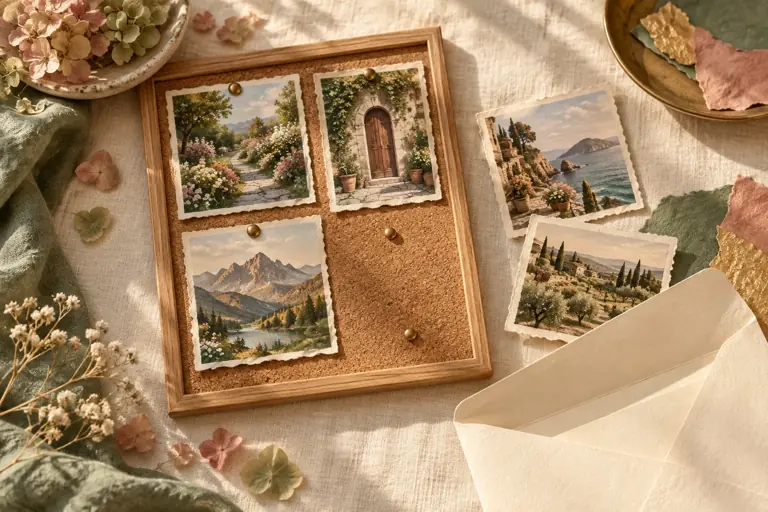
If you are wondering what to do with old vision boards, start by treating them as records of what once appealed to you—not forecasts you were required to fulfil. Look at each image, identify what it represented, and decide whether that meaning still fits. Keep, reinterpret, archive or remove items according to your current priorities.
The goal is not to grade your manifestation ability. It is to learn from the distance between an earlier picture of life and the life you now understand more clearly.
Begin without scoring the board
Before counting what happened, notice the assumption behind the count. Are you treating the board as inspiration, a list of commitments or a promise about the future? Those are different things.
An image may have represented curiosity rather than a firm intention. Another may have been chosen because it looked beautiful. Something you wanted then may no longer make sense now.
Set aside the question “Did I manifest it?” for the first pass. Ask instead, “What was I trying to express?” That question allows the board to become information rather than a verdict.
If the board brings up disappointment, you do not need to make yourself feel grateful for it immediately. You can look at one item, take a break or decide not to review it today.
Translate pictures into plain language
Choose one image and describe what it meant when you selected it. Be more specific than “success” or “happiness.”
A house might have represented privacy, stability, room for guests or a particular aesthetic. A photograph of travel might have represented freedom, rest, novelty or distance from an exhausting routine. A person on a stage might have represented recognition, expression or belonging.
Write the meaning beside the image. If you cannot remember, note that rather than inventing a story. Your interpretation today may differ from your original reason, and that is worth acknowledging.
This step separates the visible object from the experience you hoped it would provide. You may find that the experience remains important even when the object does not.
Use four categories: keep, reinterpret, archive, investigate
Keep an image when its meaning remains relevant and you still want to explore it. Keeping it does not make the outcome certain; it simply records a present priority.
Reinterpret an image when the underlying value matters but the exact form no longer fits. A large studio might become a protected corner for making things. A crowded dinner party might become a smaller, more consistent gathering.
Archive an image when it belongs to an earlier chapter. You can appreciate what it represented without continuing to pursue it. Archiving is not an admission that you lacked belief. You can save a photo or digital copy, remove selected images or recycle suitable paper materials if you no longer want the physical board. None of those choices requires a special disposal ritual.
Investigate an image when you need more information. Perhaps a course still interests you, but you do not know its requirements. Perhaps a location appeals to you, but you have not considered everyday life there.
These categories are an original review tool, not a test with correct answers. You can move an item between them after learning more.
Notice what happened outside the pictures
A board shows only what you knew to imagine. It may not include a meaningful friendship, a changed responsibility, a new interest or a decision that protected your time.
Make a separate list of experiences that mattered but were not on the board. Do not force them into a story that everything happened for a reason. Simply acknowledge that life contained more than the selected images.
This can make the review less narrow. If you evaluate a year only against a collage, you may overlook decisions and experiences that deserve attention on their own terms.
You may also notice real losses or constraints. They belong in the review too. A thoughtful reflection can contain both appreciation and disappointment without making either cancel the other.
Turn one relevant image into a practical question
Choose an item from the keep or investigate category. Ask what you would need to know or do before taking a responsible step toward it.
Suppose an image of a shared creative space still appeals to you. The next question might be whether you want collaboration, access to equipment or simply company while working. You could visit an open day, ask about the format or try a local group before making a commitment.
The image is now a starting point for inquiry, not an instruction to acquire the exact scene.
Avoid making a costly decision merely to make the board come true. A visual preference does not establish that a purchase, move or professional change is appropriate. Significant decisions deserve current information and relevant advice.
Build the next board differently—or do not build one
If you enjoy vision boards, you can create a smaller version with captions explaining what the images mean. Include questions as well as desired experiences. Leave space for priorities you have not yet understood.
You might choose images of qualities you want to practise rather than only objects you want to possess. A clear desk could represent attention; an open door could represent willingness to learn. Keep the interpretation personal rather than claiming that the image emits a special power.
You can also decide that a board is not useful. A list, conversation, calendar or blank page may suit you better. No format is required for pursuing a meaningful life.
The official visualization guidance from The Secret illustrates a spiritual framing that presents imagined experiences as producing external reality. This review takes a different, limited approach: images are reflective prompts, not evidence of a guaranteed causal mechanism.
Common questions
Is removing an image giving up?
Not necessarily. It may mean the desire changed, the form no longer fits or you have better information. Decide based on present relevance rather than fear of invalidating the board.
Should I keep a board until everything happens?
You do not owe an old collage indefinite loyalty. Review it when useful and let current circumstances inform your decisions.
What if nothing on the board happened?
That does not establish a defect in your thinking. Consider what the images represented, what practical steps were taken and what circumstances mattered. You can learn from the board without blaming yourself.
If you would like space to explore which parts of an old vision still belong in your next chapter, learn about Monthly Private Guidance. Sometimes clarity begins not with adding a new image, but with giving an old one a more honest meaning.